

Shifting to a more eco-friendly lifestyle is a modern necessity. Although we might not feel it right now, however, in the future, we certainly would. This would require us to switch to more eco-friendly alternatives for all of our modern needs. Most of us who are unable to adapt to an eco-friendly lifestyle usually blame the government or the popular brands for it. However, while doing this we forget that these ultimately focus on our needs. Before we expect them to take any action, we should make them realize that we as people want to live a sustainable lifestyle. Nevertheless, before we see that day, we must make sure that we do our part of the job by switching to green gadgets like pedal powered washing machine designs.
Did you know that every time you use your washing machine, you get clean clothes but an ‘unclean’ environment? It has been established that a single wash on an average consumes more than 40 liters of water. It also consumes a lot of electricity. However, it must be noted that hand-washing clothes is an exhausting and cloying option. There have been cases of people developing serious lower back ailments due to the strain from hand-washing clothes. Providing free washing machines to such people who cannot afford one is not a solution for, even today, there are many places in the world that don’t have a proper supply of electricity.
6 – Pedal-powered washing machine designs
The situation seems to get one stuck between the devil and the deep sea. To rescue us from this seemingly Catch-22 situation, we have a bunch of innovators leading the way:
1. Cyclean Bike-Powered Washing Machine
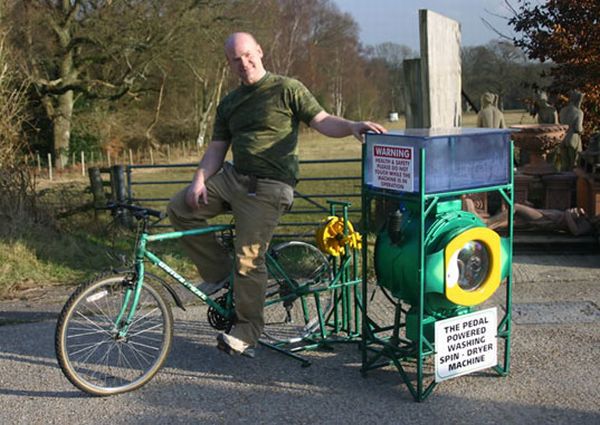
A unique combination of efficient waste management and intelligent design has given birth to Cyclean, a bike where you burn calories to clean clothes. Green enthusiast, Alex Gadsden built this prototype in the dump yard. Fitting the stripped drum and shocks of an old washing machine over a designed frame, he utilized a universal joint to connect the back of the machine to a wheelbarrow wheel. Hooking this neat contraption to a bicycle frame ensured that simple pedaling spun the internal washer chamber. A ‘neat’ way to fill up the clothesline is to cut down the waistline and increase the environmental lifeline.
2. Bicilavadora
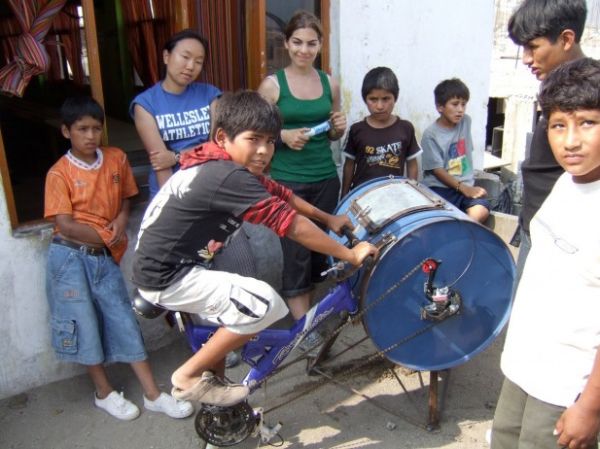
The Cyclean may not be a viable option in developing countries where one does not find washing machines in a dump yard. ‘Bicilavadora’ which is Spanish for ‘bicycle washing machine’ has been designed by an enthusiastic student group from the Massachusetts Institute of Technology. Unpacking a light suitcase and assembling the plastic panels, you get the inner drum-outer drum combination of the washing machine. Thus, it is very easy to assemble the machine. It consists of materials most of which are readily available in the developing world. As seen in the picture, children of an orphanage in Peru have suddenly developed a liking to washing clothes.
The human motor works on a bicycle sans its wheels. To move the washing machine into the spin mode from the wash mode, all one has to do is to simply shift the cycle to high gear. A standard oil drum which is suitably modified and compacted forms the exterior. Thus, all the construction materials used are tough and durable.
3. Mobile Washing Machine
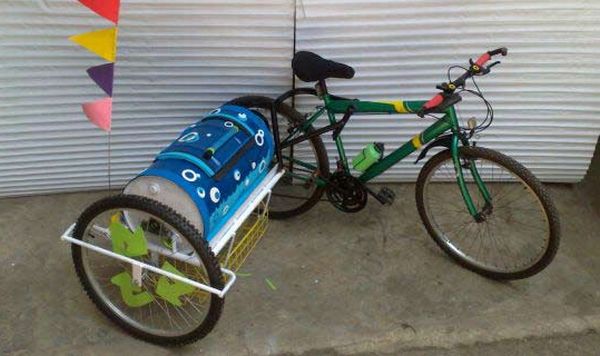
Here comes a creative design that promises to be a truly ‘moving’ experience. The connections and working are the same as in the previous two designs. But there is one vital difference â you need not pedal in a ‘static mode’. Go for a joy ride along the beach or to the market for completing the weekly shopping. Your clothes will be clean by then. This bike with its 30 gallon washing drum has been crafted by Mitch Shivers from Philippines.
4. Human-Powered Washing Machine
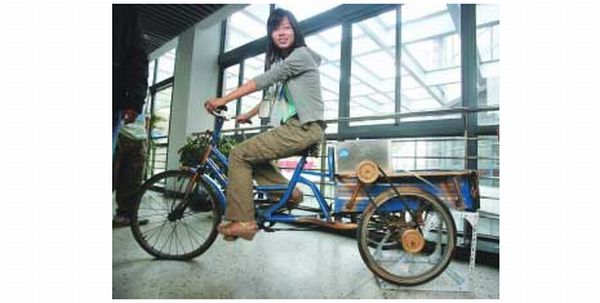
Trust the Chinese to catch up with any advancement or improvement taking place in the Western world. Few students from the Hohai University have innovated this tricycle washing machine and many interesting variants of the human-powered washing machines have cropped up since then. A kid named Zhang Jiayu has thrilled the exercise-hungry Chinese with a treadmill washing machine so that a morning jog cleans up clothes instead of only soiling them.
5. Spincycle
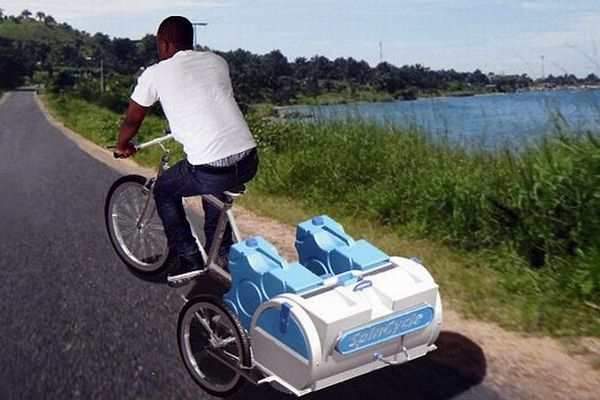
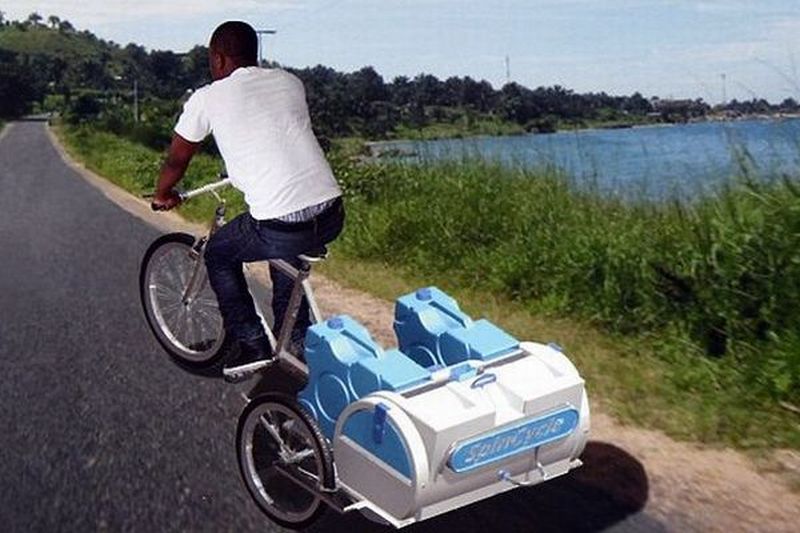
The Dark Continent has proved to be the progenitor of a very bright idea. When Richard Hewitt a graduate in product design from the Sheffield Hallam University had to wash loads of children’s clothes in an orphanage in Burundi, he innovated the Spincycle. The Spincycle features a washing machine mounted on a tricycle. Detergent and a determined-gent combo ensure clean clothes suspended in a pool of soapy water. A change in water before another ride ensures proper rinsing and the third ride spin dries the clothes.
This eco-friendly bike has an aesthetic design and more than the fitness angle, it has an important economic implication for the backward African countries. If the design is refined and developed properly, the Spincycle could well become a micro-enterprise generating valuable income for the poverty-stricken people. It is also a boon for those who are accustomed to the luxury of washing machines but are placed in regions of little or no electricity.
6. Pedal-powered washing machine from Haier
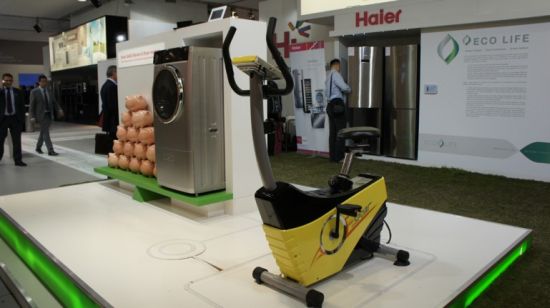
Hoping from one task to other to manage your daily schedule leaves you with very little time to keep yourself in good shape. What if there was something that could do your clothes while you hit the exercise bike? Well, the new human-powered washing machine by the Chinese electronics giant Haier promises just that. This pioneering machine includes an exercise bike that collects energy as you pedal into a lithium-ion battery, which is hard wired to the front loading machine.
Just 20 minutes of pedaling gives you one cold cycle wash without drawing power from the grid. Haier brings to your doorstep a healthy, electricity saving, money saving and green way to spotless clothing. This ingenious human-powered washing machine was recently seen at the IFA 2010. I am sure you can’t wait to see this innovative machine go beyond prototype stage.
All these washing machines truly live up to their name for they provide clean clothes and a clean environment. They provide much-needed exercise and take away the monotony of washing clothes. What are you waiting for? It is time to get involved in the ‘cleaning exercise’!